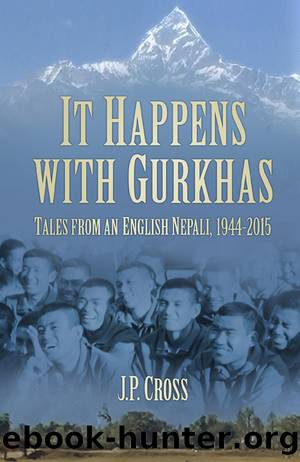
It Happens with Gurkhas by J.P. Cross
Author:J.P. Cross
Language: eng
Format: epub
ISBN: 9780750969307
Publisher: The History Press
We were in cloud, mist or rain for twenty-six out of thirty-four days. It was on the morning of the tenth day of our walk that the earthquake struck.
We were in a house by the Dudh Kosi and were all awoken by a loud, grating, stuttering noise. Our beds shook and we bolted outside. Luckily nothing in that vicinity fell down although there were cracks in the older houses. The wide river was momentarily hurled off course. In fact, we saw no major damage until we were halfway between Diktel and Khotang, the Sampsu Khola being the dividing line. The only good effect of the earthquake, apart from international goodwill shown, was that I met far more folk than I would otherwise have done as they came in to report damage to property and livestock. I therefore had a much wider audience than expected and could spread my reassuring message that, despite their fears and rumours to the contrary, the British were not abandoning the East.
The glamour and vainglory of regimental soldiering over the years of four decades had long faded but the magic of camaraderie then formed, dormant for so long, instantly and without hesitation rose to the surface everywhere I went. At eight welfare centres, in villages or on the way, names and numbers, in the main, sprang to the mind and almost everybody had his own anecdote about the times we had spent together â some true and flattering, some untrue and flattering, others neither! Looking at the menâs animated faces and shining eyes was like looking into a mirror: the once smooth-faced, clean-limbed and upright lads were sometimes scarcely recognised now that they had become shriven, wrinkled, toothless and grey-haired or bald. I, too, after so much time, was one of that large army of âthose who fade awayâ.
In all I suppose I spoke to between 450 and 500 people about the future, including 141 in Dharan, and I got the firm impression that everybody with whom I spoke accepted what I told them wholeheartedly. As I spoke to around 10 per cent of eastern hill and Dharan-based pensioners, I regard this acceptance as of great significance.
But that aside it was the reactions of one ill man and one old woman I had gone to meet that held the attention of the soldier who was with us and my Nepalese godson. The man lived in Bagsila (whither I had made a detour to visit the widow of an old friend whose two sons I had helped over the years). I was told he was ill and, from behind his house, I called his regimental number, rank and name. I found him sitting forlornly on a wooden bed in the front of his house, clutching a stool to keep himself upright. His face was puffy, he coughed and wheezed and was obviously very unhappy and very ill.
He did not grumble at his fate nor did he bewail the effects on his family but told me his troubles as though he were reporting how he had been on patrol in yesteryear.
Download
This site does not store any files on its server. We only index and link to content provided by other sites. Please contact the content providers to delete copyright contents if any and email us, we'll remove relevant links or contents immediately.
The Vikings: Conquering England, France, and Ireland by Wernick Robert(84381)
Ali Pasha, Lion of Ioannina by Eugenia Russell & Eugenia Russell(40318)
The Conquerors (The Winning of America Series Book 3) by Eckert Allan W(37983)
The Vikings: Discoverers of a New World by Wernick Robert(37006)
Cecilia; Or, Memoirs of an Heiress — Volume 1 by Fanny Burney(32636)
Cecilia; Or, Memoirs of an Heiress — Volume 2 by Fanny Burney(32010)
Cecilia; Or, Memoirs of an Heiress — Volume 3 by Fanny Burney(31996)
Empire of the Sikhs by Patwant Singh(23135)
The Secret History by Donna Tartt(19296)
Hans Sturm: A Soldier's Odyssey on the Eastern Front by Gordon Williamson(18649)
Cat's cradle by Kurt Vonnegut(15441)
Pimp by Iceberg Slim(14666)
Sapiens: A Brief History of Humankind by Yuval Noah Harari(14461)
Norse Mythology by Gaiman Neil(13458)
Talking to Strangers by Malcolm Gladwell(13440)
Leonardo da Vinci by Walter Isaacson(13411)
4 3 2 1: A Novel by Paul Auster(12513)
Underground: A Human History of the Worlds Beneath Our Feet by Will Hunt(12145)
The Radium Girls by Kate Moore(12093)
